

Skip hire in Stilton
Stilton is a former coaching stop on the old Great North Road, where narrow village frontages and old timber-framed cottages mean the skip's position matters as much as its size.
Postcode on the next step
Get Instant PriceWhich skip do I need?Official Just Hire Partner. Bookings powered by Just Hire.
Stilton at a glance
- District councilHuntingdonshire
- Road permitsCambridgeshire County Council
- Tip for residentsAlconbury centre
- Old roadGreat North Road coaching village
A coaching village that fire rebuilt several times
The Roman road Ermine Street became the Great North Road, and Stilton grew up beside it as a posting station. By the late Middle Ages travellers were stopping here, and the Bell Inn was among the best known stops between London and the north. At one time the village had around fourteen public houses for a population of about five hundred. Fires damaged the village in 1729, 1798 and 1895, which is partly why old and newer buildings now sit side by side.
About 2,400 people live here today. The centre is a conservation area, and the village's own heritage page says many older buildings were lost over the centuries. Walk North Street and you pass a pair of eighteenth-century timber-framed cottages, once the home of an officer from the nearby Norman Cross prisoner-of-war camp.
Just Hire handles the booking: the form wants a size, a waste category and a standing place, quotes the price with VAT, and confirms after payment.
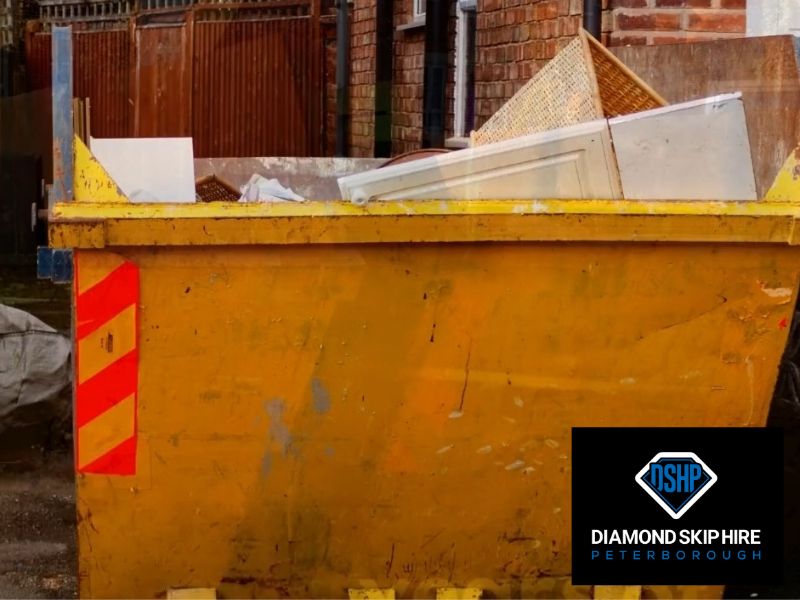
Stilton projects and which skip takes them
- 2-yard mini skipripping out an old porch or lean-to
- 4-yard midi skipstripping a bathroom in a timber-framed cottage
- 8-yard builders skipa farmhouse kitchen refit with new floors
- 12-yard maxi skipclearing a barn conversion before the builders arrive
Room for a skip across Stilton
Older properties front straight onto the street, so for many Stilton jobs the choice is between a drive, a yard or the road.
On a driveway
Farm gateways, side yards and rear courts are all private land, and a skip there needs no permit. Check the width of the entrance and the route the lorry takes in, as old village gateways can be narrow.
On the road
Stilton's roads are looked after by Cambridgeshire County Council, and Just Hire files the application for you with about five days' notice. Avoid the old main road where cars are constantly passing.
Wait and load
If the street is busy or has nowhere to put a skip, the lorry can stay while you load, then drive away with everything. It is a sensible option for a modest clear-out from the front of a house.
Why the old main road complicates a road skip
Stilton's historic spine is a road built for horses and coaches, widened for early motor traffic and now relieved by the A1. Even so, the village streets can feel tight, and where houses stand right on the back of the pavement there is nowhere for a skip except the carriageway.
That brings the permit rules into play. Cambridgeshire County Council deals with them: the application is online with a risk assessment, a permit lasts 14 days, and the county turns down any spot on yellow lines. Just Hire takes care of the paperwork when you pick a road spot, and the booking page allows roughly five days for it, so set the delivery that far ahead of any fixed start.
Our permit and placement guide sets out the rules about lights and markings that apply once a skip is on the road.
Timber frames, thatch history and old fabric
Stilton's fires of 1729, 1798 and 1895 are a reminder that many roofs here were once thatch, and the surviving buildings show a mixture of timber frame, brick and tile. Older houses often have lime plaster, lath, horsehair and early brick, and stripping them out produces an unusual mix of dust, timber and rubble.
A conservation area covers the village centre, according to the parish's own landmarks page. Huntingdonshire's published list of conservation area appraisals does not include Stilton, so check with the district planning team about the boundary before you alter anything outside the walls of your house. Listed building consent is a separate matter altogether and applies to anything on the national list.
Keep the contents of an old house sorted as you strip it. Timber that is sound might be worth reusing, and anything old and decorative, such as fire surrounds, doors and ironmongery, can be sold on rather than thrown away. The rest goes in as mixed waste, with plasterboard kept apart. Our guide to renovating with a skip explains how to stage a strip-out.
Farm buildings, barns and paddocks
Stilton's parish stretches out into farmland, and edge-of-village properties often come with a paddock, a barn or a yard. These produce their own kind of waste: rotted fencing, old gates, wire, pallets, hay-store timber and sheeting. Fencing should be cut to length before loading, and wire should be coiled, since loose wire catches and tears lorry sheets.
Barn conversions are a distinct case. Taking out old stalls, concrete floors and tin roofing will fill a 12-yard skip fast, and the weight of concrete usually means hardcore goes separately. If a floor is coming up, ask the builder how much there is before choosing the size; the sizing guide will help with the arithmetic.
Soil from groundworks is a separate waste type, so keep spoil away from other materials as you dig.
Paddock clearance brings a particular headache: ragwort, nettles and thistles pulled by hand add up to a surprising bulk. They are plain garden waste, but tie them in sacks if the skip will be sitting for several days, since a pile of green material warms up and smells. Old horse-trough ironwork and rusted gates are heavy, so lay them at the bottom and spread the weight evenly.
The Alconbury tip and what it will not take
Stilton residents usually use the Alconbury household recycling centre, one of nine run by Thalia for Cambridgeshire. Details of opening hours are on the county's website, and the gates close ten minutes before the posted time.
The site is a good example of why a skip makes sense for a big job. Alconbury does not take paint, because most county sites do not accept it. It also does not accept plastic bottles, which the county lists only for Bluntisham, Milton, St Neots, Thriplow and Witchford. No county site accepts car tyres, and tradespeople and man and van traders are barred.
Plasterboard is accepted at Alconbury if it is clean, meaning free of tiles, plaster, wood and rubble. Anything dangerous should be handled as set out in our guide to hazardous waste, and a skip cannot take it either.
The cheese that was never made here
Stilton gave its name to the blue cheese because it was sold here, on the coaching route, rather than made here. Rules protecting the name mean that no cheese made in the village can be sold as Stilton, and a request in 2013 to change that was rejected. The Bell Inn, which first marketed the cheese according to the cheesemakers' association, later closed and fell into disrepair.
The story points to something about the village: it has always been a place that people pass through. That affects clear-outs. Traffic moves steadily past, and a pile of waste beside a front door attracts attention. Keep the rubbish inside the skip, not around it, and keep to the cones and lights the road rules require.
Norman Cross and the surrounding lanes
The Norman Cross depot, built in 1796 and 1797 for French prisoners, stood just south of the village, and the area still carries the name. Stilton is recorded in Domesday Book in the Hundred of Normancross. For householders, the legacy is mostly a pattern of long lanes, scattered farms and houses set well apart.
That makes access a real issue. A lorry carrying a skip is a large vehicle, and some of the roads out of the village are narrow, with soft verges and overhanging hedges. If the property is down a long track, mention it on the booking, and be ready to cut back anything low. Lay boards on grass or gravel if heavy loads are going to stand for days.
Mud is the other seasonal hazard. After wet weather a lane can be too soft for a loaded lorry to leave safely, and a supplier may need to rearrange the visit. Keep a hard surface at the gateway, and have gravel or planks to hand so the lorry can get in and out.
House moves, probate and tenancy changes
Property changes hands steadily in a village on a main route, and each sale generates a clear-out. A deceased relative's home, a house being readied for sale or a rental between tenants will fill a skip with furniture, carpets and boxed possessions. Take charity-shop items out first, set aside valuables and papers, and be careful with electrical goods, which cannot go in a general skip.
Houses with long gardens and old sheds can hide years of accumulated rubbish at the far end, so walk the whole plot before you decide on a size. A quick sketch of what is in each outbuilding gives a fair guide to the total, and it is better to book one size up than to leave a heap beside a full skip.
A whole house usually needs a 12-yard or larger skip, and where bulky furniture is the main part of the job, the 14 or 16-yard sizes are worth considering if there is a drive big enough. If the house has no off-street space, a wait-and-load session is a straightforward alternative.
The live price for a given address and size appears on the booking page.
Frequently asked questions
Who signs off a road skip in Stilton?
Cambridgeshire County Council, as the highway authority. Choosing a road position passes the application to Just Hire, and five days or so covers it.
Is Stilton's conservation area a problem for hiring a skip?
Not for the skip itself. It matters if the work involves trees, walls or the outside of a building, which the district planning team can advise on.
Which tip do Stilton residents use?
Alconbury is the usual choice. It does not take paint, plastic bottles or car tyres, and man and van traders are refused at the gate.
Can a skip stand outside a house on the old Great North Road?
Only with a county permit, and not on yellow lines. On a busy frontage, wait and load is often easier.
What size suits a barn conversion clear-out?
A 12-yard skip is a common choice for a barn. Keep concrete and rubble separate as hardcore, because it is heavy.